

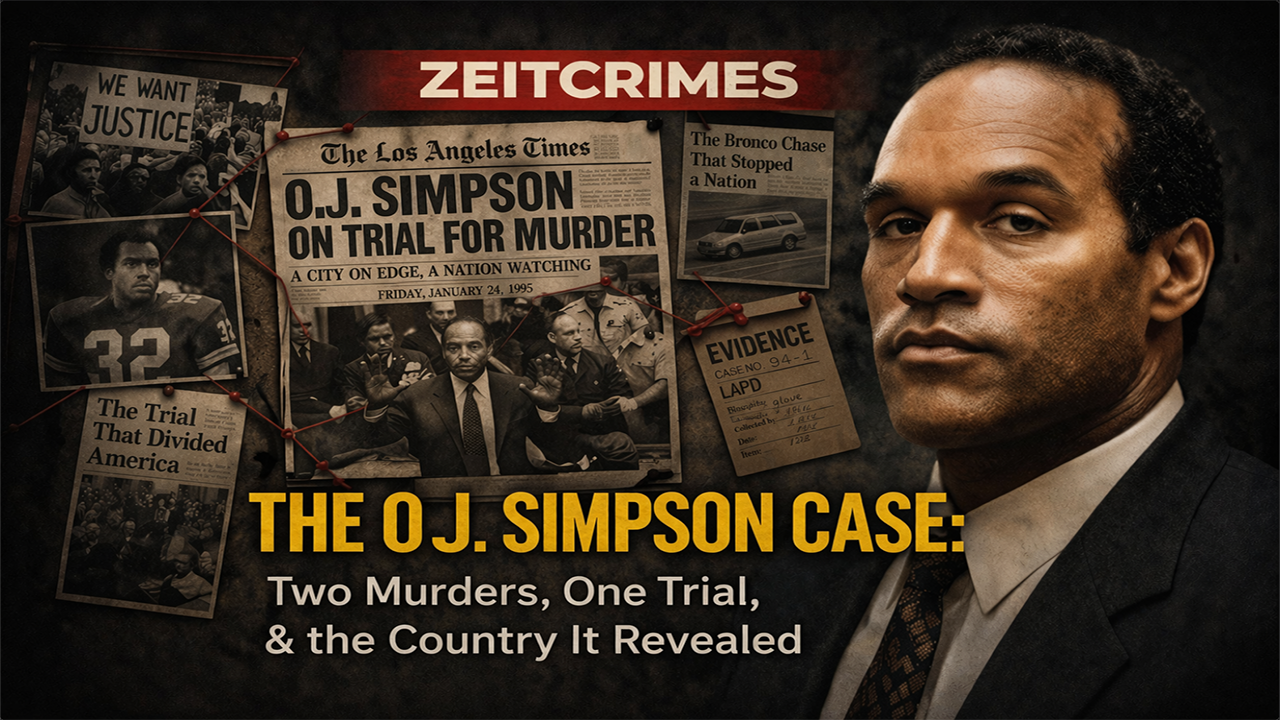
Editorial Note
The O.J. Simpson case is the most publicly examined criminal case in American history. It was watched, in real time, by more people than any legal proceeding before or since. Its verdict was experienced, simultaneously, as a victory and a travesty, depending on who was watching and what they had brought with them to the television screen. And in the thirty years since the not-guilty verdict on October 3rd, 1995, the case has remained controversial.
I want to be transparent, at the outset, about what this episode is and what it is not.
It is not another exercise in relitigating the trial. Whether O.J. Simpson killed Nicole Brown Simpson and Ronald Goldman has been the subject of more analysis, more argument, and more certainty on all sides than any criminal verdict in recent memory. The civil jury that found him liable in 1997 was as certain as the criminal jury that acquitted him in 1995. The mountain of evidence has been examined from every angle. My purpose is not to add to that mountain or to climb it again.
What then is this episode about? It is a complete account of the murders, the investigation, the trial, and the people involved — and then an honest, serious engagement with what the case meant and what it revealed. What it revealed about domestic violence and how it is treated in American law and culture. What it revealed about the relationship between race, wealth, and the American criminal justice system. What it revealed about media and the transformation of criminal proceedings into entertainment. What it revealed about the specific moment in American history — post-Rodney King, post-Los Angeles uprising, three years into the Clinton era — in which it occurred.
Two people are dead. Nicole Brown Simpson was thirty-five years old. Ronald Lyle Goldman was twenty-five years old. They were killed on the night of June 12th, 1994, outside Nicole's condominium in Brentwood, Los Angeles. They were murdered brutally, with a knife, by someone who knew what they were doing. They deserve to be the center of this story. The degree to which the subsequent proceedings displaced them from that center — replaced them with a debate about race and justice and celebrity — is itself one of the most important things the case reveals.
Content Note
This episode discusses domestic violence in detail, including the documented history of violence in Nicole Brown Simpson's marriage. It discusses two homicides in forensic detail. It engages directly with the racial history of the Los Angeles Police Department and with the structural racial inequities of the American criminal justice system. Please take care of yourself.
Cold Open
Brentwood, June 1994
June 13th, 1994. 12:10 in the morning. Brentwood, Los Angeles. A neighbor is walking his dog, a large Akita, along the sidewalk of Bundy Drive when he notices that the dog — which is not his dog — is whimpering and agitated and has blood on its paws. He follows the dog. The dog leads him to the front walkway of 875 South Bundy Drive, a condominium in the upscale residential neighborhood of Brentwood.
He does not go to the front door. He calls to neighbors. A neighbor calls 911.
When the Los Angeles Police Department arrives, they find two bodies. A woman lies on the front walkway near the entrance to the condominium. She is thirty-five years old. She has been stabbed multiple times and her throat has been cut so deeply that she is nearly decapitated. A man lies at the foot of the walkway near the front gate. He is twenty-five years old. He has been stabbed multiple times. His hands show defensive wounds from fighting back. A bloodied glove is found near his body. There are no witnesses. There is no murder weapon. There is an enormous amount of blood where the victims lay.
A few miles to the north, in Rockingham Avenue in Brentwood, in a large estate house, the owner of the property is not home. He is, according to his account, somewhere in his house, or asleep, or hitting golf balls in his backyard. He is, as the investigation will establish, one of the most famous men in America.
The woman's name is Nicole Brown Simpson. The man's name is Ronald Lyle Goldman. The owner of the Rockingham estate is Orenthal James Simpson.
What follows is the most watched, most argued, most consequential criminal proceeding in the history of American law. And it begins with two people who are dead, on a walkway in Brentwood, in the early minutes of a June morning.
I am your host, Rene Hinojosa, and this is ZEITCRIMES. Today's episode is titled "The O.J. Simpson Case: Two Murders, One Trial, & the Country It Revealed." What happened, who was involved, the evidence gathered, what the trial produced, and what all of it meant for America in 1995 and in the thirty years since.
When the Los Angeles Police Department arrives, they find two bodies. A woman lies on the front walkway near the entrance to the condominium. She is thirty-five years old. She has been stabbed multiple times and her throat has been cut so deeply that she is nearly decapitated. A man lies at the foot of the walkway near the front gate. He is twenty-five years old. He has been stabbed multiple times. His hands show defensive wounds from fighting back. A bloodied glove is found near his body. There are no witnesses. There is no murder weapon. There is an enormous amount of blood where the victims lay.
A few miles to the north, in Rockingham Avenue in Brentwood, in a large estate house, the owner of the property is not home. He is, according to his account, somewhere in his house, or asleep, or hitting golf balls in his backyard. He is, as the investigation will establish, one of the most famous men in America.
The woman's name is Nicole Brown Simpson. The man's name is Ronald Lyle Goldman. The owner of the Rockingham estate is Orenthal James Simpson.
What follows is the most watched, most argued, most consequential criminal proceeding in the history of American law. And it begins with two people who are dead, on a walkway in Brentwood, in the early minutes of a June morning.
This content requires The Investigator or higher.
Sign InSegment One
Los Angeles, 1994
The City and the Moment
Los Angeles in June of 1994 was a city still processing trauma. On April 29th, 1992, the acquittal of four LAPD officers charged with the beating of Rodney King — a beating that had been captured on videotape and broadcast to the entire country — had ignited the Los Angeles uprising, six days of rebellion that killed sixty-three people, injured more than two thousand, and caused over a billion dollars in property damage. It was the most destructive urban uprising in American history since the 1967 Detroit rebellion.
The specific context of the Rodney King beating and its aftermath is essential to understanding the O.J. Simpson case, because the Simpson case was tried in a city that had, two years earlier, watched its police department be acquitted of an assault captured on video.
The LAPD's relationship with Black Los Angeles was not simply strained in 1994. It had been, for decades, a relationship defined by brutality, racial profiling, and systematic abuse. The King beating was not an aberration. It was a documented pattern made visible.
The LAPD under Chief Daryl Gates, who led the department from 1978 to 1992, had been the subject of sustained criticism from the Black community, from civil rights organizations, and eventually from the Christopher Commission, the independent inquiry established after the King beating, which documented widespread use of excessive force, racist language in official communications, and a departmental culture of impunity. The Christopher Commission's 1991 report found that 44 officers had received the most complaints for excessive force, and that the department's management had failed to act on those complaints consistently.
This is the institutional context in which the LAPD investigation of the Simpson case would unfold, and it is the context in which the defense team would make its most powerful arguments. The question of whether the LAPD had contaminated or manufactured evidence against O.J. Simpson was not a paranoid fantasy invented for the trial. It was grounded in a documented history of misconduct that the jury, and Black Los Angeles broadly, had every reason to take seriously.
At the same time, Los Angeles in 1994 was a city in which domestic violence — intimate partner violence, the abuse of women by men who claim to love them — was a largely invisible and dramatically under addressed crisis. The statistics were not unknown to advocates and researchers: domestic violence was the leading cause of injury to women in the United States. Women were more likely to be killed by intimate partners than by strangers. The legal and cultural response to this crisis was inadequate in ways that were systematic and documented.
These two realities — the LAPD's documented racism and the culture of dismissal toward domestic violence — were both present, simultaneously, in the same case. They were not in opposition to each other. They were both true. And the trial forced them into a direct confrontation that the country was not equipped to handle honestly.
Segment Two
The People — Who They Were
Nicole Brown Simpson
Nicole Brown was born on May 19th, 1959, in Frankfurt, West Germany, where her father, Louis Brown, was stationed with the United States Army. The family — Nicole, her parents, and her three sisters — moved back to the United States when her father completed his service, eventually settling in Laguna Beach, California, where Nicole grew up.
She was, by all accounts of people who knew her, a person of warmth, energy, and genuine beauty — someone who filled a room, who was devoted to her friends and her family, who was a dedicated and loving mother to her children. She met O.J. Simpson when she was eighteen years old and working as a waitress at a Beverly Hills restaurant called The Daisy. She was a teenager. He was thirty years old, one of the most famous athletes in America, already married to his first wife Marguerite Thomas.
The relationship that began then would last seventeen years, through a marriage in February 1985, the births of two children — Sydney Brooke Simpson in October 1985 and Justin Ryan Simpson in August 1988 — a divorce in October 1992, and then a period of on-and-off reconciliation attempts until the weeks before her death. She was killed on June 12th, 1994. She was thirty-five years old. Her children were eight and five.
The history of violence in Nicole Brown Simpson's marriage to O.J. Simpson is not incidental to this case. It is central to it. The documented record of physical abuse, documented in police reports, in a 911 call that Nicole made in January 1989 when Simpson was beating her and that was played at the criminal trial, in Nicole's own diary, and in the testimony of friends and family members, is one of the most important pieces of context for understanding what happened on June 12th, 1994.
On New Year's Day, 1989, Los Angeles police responded to a call at the Rockingham estate and found Nicole with a black eye, a split lip, a cut cheek, and bruising consistent with being struck multiple times. Simpson was charged with spousal battery. He was sentenced to community service, a fine, and psychological counseling, none of which he completed as required. The 911 call from that incident was played at the criminal trial and became one of the most devastating pieces of audio evidence in the history of American courtrooms.
The 1989 incident was not the first or the last documented act of violence. Nicole kept a diary in which she described multiple instances of physical and psychological abuse. Friends and family testified to seeing injuries and receiving distressed calls. In October 1993 — eight months before her death — Nicole called 911 during a confrontation with Simpson at the Rockingham estate. Her voice on that recording communicates terror that is immediate and unmistakable.
Nicole Brown Simpson was not a symbol or a cultural signifier. She was a mother, a daughter, a friend, a woman who had been in a relationship with a violent man for most of her adult life and who, in the two years since the divorce, had been trying to build an independent life. She was thirty-five years old. She had eight-year-old and five-year-old children who would grow up without her.
Ronald Lyle Goldman
Ronald Lyle Goldman was born on September 2nd, 1968, in Chicago, Illinois, the son of Fred Goldman and Sharon Rufo. His parents divorced when he was young, and he grew up primarily with his father and his father's second wife, Patti Glass Goldman, who adopted him. The family was close and Ron was, by all accounts, a young man of significant charm and energy — outgoing, funny, the kind of person who formed friendships easily and maintained them.
He had moved to Los Angeles to pursue a career in the entertainment industry or in restaurant management, the two overlapping worlds that constituted so much of the city's working social life. By June 1994, he was twenty-five years old and working as a waiter and aspiring model. He was a friend of Nicole Brown Simpson's, having met her at the restaurant where he worked. He had been at Nicole's condominium that night to return sunglasses that Nicole's mother had left at the restaurant.
He was not in a romantic relationship with Nicole at the time of his death, despite what early press accounts suggested. He was her friend. He was twenty-five years old, visiting a friend to return a lost item, and he was killed for it. His father Fred Goldman became, in the years following the verdict, one of the most persistent and determined advocates for civil accountability, pursuing Simpson through the civil courts with a focus and determination that ultimately produced a civil judgment of approximately $33.5 million against Simpson — a judgment that Simpson mostly evaded paying for the rest of his life.
Ron Goldman deserves to be remembered as a person, not as a plot element in a case about someone else. He was twenty-five years old. He was someone's son. He was returning a pair of sunglasses.
Orenthal James Simpson — Background
Orenthal James Simpson was born on July 9th, 1947, in San Francisco, California, the third of four children of Jimmy Lee Simpson and Eunice Durden Simpson. He grew up in the Potrero Hill neighborhood of San Francisco, a working-class neighborhood with a significant Black population. His father left the family when O.J. was a young child, and his mother raised the family largely on her own while working as an orderly at a San Francisco hospital.
His childhood was not affluent. The Potrero Hill Boys Club provided him with a social structure and a path that, through youth football, led to one of the most remarkable athletic careers in American history. He attended Galileo High School, then City College of San Francisco, then the University of Southern California, where he played for the Trojans and won the Heisman Trophy in 1968, the award given to the most outstanding college football player in the country.
He was drafted by the Buffalo Bills in 1969 and spent most of his NFL career there, becoming one of the most dominant running backs in the history of professional football. In 1973, he rushed for 2,003 yards in a single season — the first player in NFL history to rush for more than 2,000 yards — a record that stood for many years and that established him as one of the greatest players of his generation. He was known universally as 'The Juice.' He was beloved by fans across racial lines in a way that very few Black athletes of his era were — carefully, deliberately non-threatening in his public persona, the star of Hertz car rental commercials in which he ran through airports, a film actor, a sports broadcaster.
This public persona — the smiling, charming, universally appealing O.J. Simpson who transcended race — was the persona that the trial would interrogate and ultimately shatter. The private O.J. Simpson, documented in police reports and 911 recordings and the testimony of those who knew him in his domestic life, was a man who beat his wife repeatedly over many years and who experienced the end of his marriage as a loss of control that he was unable to accept.
O.J. Simpson died on April 10th, 2024, at the age of seventy-six, of prostate cancer. He had been acquitted of the murders of Nicole Brown Simpson and Ronald Goldman in October 1995. He had been found liable for their deaths by a civil jury in February 1997. He had been convicted in 2008 of armed robbery and kidnapping in a Las Vegas incident related to his attempt to retrieve sports memorabilia, and had served nine years in prison before being paroled in 2017. He maintained his innocence in the murders for the rest of his life.
The Key Investigators
Detective Tom Lange was a twenty-seven-year veteran of the LAPD homicide division and one of the two lead detectives on the Nicole Brown Simpson and Ronald Goldman murder case. He was assigned the case when he was called to Bundy Drive on the morning of June 13th. Lange was a methodical and experienced homicide detective who testified extensively at the criminal trial. His investigation has been both praised for its thoroughness in collecting evidence and criticized for specific procedural decisions that became central to the defense's case.
Detective Philip Vannatter was Lange's partner on the case, a thirty-year LAPD veteran who had worked hundreds of homicide investigations. Vannatter's decision on the morning of June 13th to go to the Rockingham estate to notify Simpson of his ex-wife's death, rather than remaining at the crime scene or seeking a warrant before entering the property, was one of the most consequential procedural decisions of the case. It was at the Rockingham estate that Detective Mark Fuhrman found a bloody glove that matched one found at Bundy Drive — and it was Fuhrman's background that became one of the central issues of the trial.
Detective Mark Fuhrman was the LAPD detective who discovered the Rockingham glove. His involvement in the case became, over the course of the trial, the most explosive issue in the proceedings. Fuhrman was a fifteen-year LAPD veteran who had testified on the stand that he had not used the word 'nigger' in the previous ten years. The defense subsequently produced audiotapes of Fuhrman, recorded for a screenplay project, in which he used the word extensively and described, in graphic terms, planting evidence on suspects, beating arrested individuals, and covering up for fellow officers. The revelation of these tapes, which came in August 1995 — after Fuhrman had testified on the stand under oath that he had not used the word — was the most significant single moment in the defense's case. Fuhrman ultimately invoked his Fifth Amendment right against self-incrimination when asked whether he had planted the Rockingham glove.
Fuhrman was convicted in 1996 of perjury for his trial testimony and was sentenced to three years' probation. He moved to Sandpoint, Idaho and became, improbably, a true crime author and radio commentator. Several of his books have been bestsellers. He continues to argue that Simpson was guilty and that the glove was not planted.
The Prosecution Team
Marcia Clark was the lead prosecutor in the Simpson criminal trial, an experienced Los Angeles County Deputy District Attorney who had an excellent conviction record and who had been assigned to the case because of her ability as a trial lawyer. She was forty years old at the start of the trial. Her competence as a prosecutor was genuine, but she faced challenges that went far beyond the legal: she was a woman prosecuting a case that would be defined by issues of race and celebrity and media in ways that no previous prosecutor had encountered at this scale.
Clark was subjected to relentless media scrutiny of her personal appearance, her divorce proceedings, her custody arrangements for her children, and her manner of dress and presentation. A court hearing about custody of her children was reported as major news. A tabloid published photographs of her sunbathing. The coverage she received was a sustained demonstration of the specific kind of sexist scrutiny that women in high-profile positions received in 1995 and still receive, and it constituted a significant additional burden on an already extraordinarily demanding case.
She and co-prosecutor Christopher Darden made the decision to have Simpson try on the gloves in court — the decision that produced the moment that defined the trial and arguably lost the case. She has discussed this decision extensively in subsequent interviews and writings, acknowledging it as a catastrophic error while arguing, with some force, that the case as a whole was winnable even with the glove moment and that other factors — particularly the Fuhrman tapes — were the more decisive elements of the outcome.
Christopher Darden was a Black Deputy District Attorney who was added to the prosecution team, in part, because of the racial dynamics of the case. He had been a prosecutor for fourteen years and was highly regarded in the DA's office. His presence on the prosecution team was intended to demonstrate that the case was not racially motivated, and he was responsible for some of the most effective parts of the prosecution's presentation, particularly the domestic violence evidence. His relationship with Clark during and after the trial has been the subject of considerable public speculation, some of it based on their own subsequent statements and some of it not.
Darden's post-trial career was complicated by the case. He left the District Attorney's office, taught at California Western School of Law, and worked as a defense attorney and legal commentator. His later career included some controversy, including a 2020 incident in which he withdrew from representing a client accused in the murder of rapper Nipsey Hussle after filing a motion identifying a confidential informant. He later resumed his legal career.
The Defense: The Dream Team
The defense team assembled by O.J. Simpson and his advisers was, and remains, the most celebrated and most criticized defense team in American legal history. It was called the Dream Team by the press, a phrase that captured both its extraordinary legal talent and the degree to which its assembly — requiring enormous financial resources available to almost no criminal defendant — illustrated the gap between the legal representation available to the wealthy and the legal representation available to everyone else.
Robert Lee Shapiro was the lead defense attorney in the early stages of the case. He was a prominent Los Angeles criminal defense attorney who had represented celebrities and public figures and who had developed a specific skill at managing high-profile cases. Shapiro was the attorney who advised Simpson on the day after the murders and who was present throughout the early investigation. His role diminished as the trial progressed and Johnnie Cochran became the dominant figure.
Johnnie L. Cochran Jr. was the attorney who became the face of the Simpson defense and who delivered the trial's most memorable line. He was one of the most prominent civil rights attorneys in Los Angeles — a man who had spent his career fighting police misconduct and who had, in multiple cases, documented and challenged the LAPD's treatment of Black suspects. His addition to the defense team was significant not merely for his legal skill but for what he represented: someone who understood, from deep professional experience, the specific dynamics of LAPD misconduct that were at the center of the defense's case.
Cochran's closing argument — and specifically his instruction to the jury, 'If it doesn't fit, you must acquit,' referring to the gloves — became the most quoted line from any American trial in the history of television. He died on March 29th, 2005, of an inoperable brain tumor. He was sixty-seven years old.
F. Lee Bailey was one of the most famous criminal defense attorneys in the United States at the time of the Simpson trial. He had represented Sam Sheppard in his successful retrial, Patricia Hearst, and Albert DeSalvo, the accused Boston Strangler. He was brought onto the Simpson team specifically to cross-examine Mark Fuhrman, and the cross-examination he conducted — in which he asked Fuhrman directly whether he had used the word 'nigger' in the preceding ten years — was the trap that Fuhrman fell into.
The revelation months later that Fuhrman had lied under oath about using the word, demonstrated by the audiotapes, was the direct consequence of Bailey's cross-examination strategy. Whether Fuhrman had planted the Rockingham glove was never definitively established. What was established was that he had committed perjury on the stand about a racially charged issue in a case built on physical evidence that he had found.
Bailey's subsequent career was disastrous. He was disbarred in Florida in 2001 after a contempt of court citation related to a drug case, and his Massachusetts license was revoked shortly thereafter. He spent years attempting to rebuild his legal career.
Barry Scheck and Peter Neufeld were the DNA experts on the defense team who conducted what remains, by the assessment of most forensic scientists who have reviewed it, the most effective cross-examination of DNA evidence ever conducted in an American courtroom. Scheck and Neufeld would go on, after the trial, to found the Innocence Project, the organization that has used DNA evidence to exonerate over 375 wrongfully convicted people. Their argument about the DNA evidence in the Simpson case was not that DNA was unreliable in general but that the specific collection, storage, and handling of the biological evidence in this case was so contaminated and so poorly documented that the results were not trustworthy.
Robert Blasier was a computer and DNA specialist on the defense team who worked alongside Scheck and Neufeld. Alan Dershowitz, the Harvard Law professor and prominent appellate attorney, served as the appellate expert. Carl Douglas was a partner in Cochran's firm who played a central role in the day-to-day management of the case.
Judge Lance Ito
Lance Allen Ito was a Los Angeles County Superior Court judge who was assigned to the Simpson case by random judicial assignment. He was forty-four years old at the start of the trial. He was the son of Japanese Americans who had been interned during the Second World War and had built a legal career of distinction. He was, by the accounts of attorneys who had practiced in his courtroom before the Simpson case, a careful and capable judge who ran well-organized proceedings.
The Simpson trial was, by any measure, unlike anything any judge had previously managed. The combination of the media circus, the extraordinary legal talent on both sides, the daily provocations and maneuvers of the defense, and the sheer duration of the proceedings — which lasted 372 days — produced a courtroom environment that strained any judge's capacity to maintain control. Ito has been criticized, extensively and by legal scholars who know what they are talking about, for specific decisions: allowing the television cameras in the courtroom, managing the pace of proceedings too loosely, and failing to control the behavior of counsel in ways that contributed to the proceedings' chaotic character.
Ito appeared, at various points, to enjoy the celebrity of the case in ways that did not always serve the interests of justice. The late-night comedians who built running jokes around his name and his management of the trial were responding to something real about how the case was being conducted.
He retired from the bench in 2015 after twenty-seven years as a judge. He has given very few interviews about the case since the trial.
Key Witnesses and Other Parties
Brian 'Kato' Kaelin was a houseguest at the Simpson Rockingham estate who occupied a guest cottage on the property at the time of the murders. He was twenty-eight years old, an aspiring actor who was living rent-free at the estate in exchange for various household tasks. He testified that he had heard loud thumping noises against his cottage wall at approximately 10:45 p.m. on June 12th, the night of the murders — a time that investigators believed was consistent with Simpson returning from Bundy Drive. His relationship with prosecutors became famously contentious when he appeared reluctant to provide testimony that fully supported the prosecution's timeline. He was declared a hostile witness.
Kato Kaelin became, in the cultural aftermath of the trial, one of the more peculiar celebrity byproducts of the proceedings: a minor celebrity for simply having been present in a famous case. He has continued to work as an actor and television personality.
Allan Park was a limousine driver who had been hired to pick up Simpson and take him to the Los Angeles airport for a late-night flight to Chicago. He arrived at the Rockingham estate at approximately 10:22 p.m. on June 12th and rang the buzzer at the gate multiple times without response for over an hour. At approximately 10:56 p.m., he saw a large Black figure walk across the driveway toward the house. Shortly thereafter, the intercom responded and Simpson, who said he had overslept, emerged and got into the limousine. Park's testimony was one of the prosecution's most important pieces of evidence, establishing a timeline that placed Simpson away from the estate during the period when the murders were committed and returning to it shortly before Park arrived.
Fred Goldman, Ron Goldman's father, became one of the most prominent and persistent voices in the aftermath of the criminal acquittal. He pursued the civil case with relentless determination and has maintained a public presence advocating for accountability in the case ever since. His grief, and his anger, have been sustained and public for thirty years. He died on June 15th, 2024, approximately six weeks after O.J. Simpson's death, at the age of seventy-eight.
Denise Brown, Nicole's older sister, became one of the most important public advocates for domestic violence awareness in the aftermath of the trial. She has worked with the Nicole Brown Simpson Charitable Foundation since its establishment and has been a persistent voice for the victims of intimate partner violence in California and nationally.
Arnelle L. Simpson was O.J. Simpson's daughter from his first marriage, who lived on the Rockingham estate at the time of the murders. She was twenty-five years old and testified at the criminal trial.
Segment Three
The Murders and the Investigation
The Night of June 12th, 1994: What Is Known
The established timeline of the events of the night of June 12th, 1994, is this: Nicole Brown Simpson had attended a dance recital at Paul Revere Middle School in Brentwood in which her daughter Sydney performed. O.J. Simpson attended the same recital but sat separately. After the recital, Nicole had dinner with her family at the Mezzaluna restaurant on San Vicente Boulevard in Brentwood — the restaurant where Ron Goldman worked as a waiter. Ron Goldman was not working that evening, but he was present at the restaurant.
After dinner, Nicole's mother, Juditha Brown, discovered she had left her sunglasses at the restaurant. She called Nicole to report this, and Nicole called the Mezzaluna and spoke to Ron Goldman. Goldman agreed to bring the sunglasses to Nicole's condominium at 875 South Bundy Drive. He arrived at approximately 9:40 to 9:45 p.m. He was apparently walking toward the front door when he was attacked. Nicole was killed either at the same time or shortly before or after Goldman. The medical examiner's analysis suggested that Nicole had been killed first.
The cause of death for both victims was multiple stab wounds and incised wounds inflicted with a single-edged knife. The brutality of the attack — the depth of the wounds, the completeness of the severing of Nicole's throat, the number of wounds on Goldman — was consistent with an attacker in a rage-state who had a personal relationship with at least one of the victims.
O.J. Simpson was at the Rockingham estate for most of the evening. A limousine was scheduled to take him to Los Angeles International Airport for an 11:45 p.m. flight to Chicago, where he had a golf event the following morning. The prosecution's theory was that Simpson drove from Rockingham to Bundy Drive, committed the murders, returned to Rockingham, and was then seen by the limousine driver crossing the driveway before answering the buzzer.
The prosecution's timeline required Simpson to have committed both murders between approximately 10:15 and 10:40 p.m. — a window that was tight but not impossible given the distance between the locations and the nature of the crime. The defense argued the timeline was not plausibly achievable and that the physical evidence, including the absence of significant blood at the Rockingham estate other than a glove and trace amounts on a sock found in Simpson's bedroom, was inconsistent with someone who had just committed two brutal murders.
The Physical Evidence: What Was Found and What Was Contested
The physical evidence in the Simpson case was extensive, and its collection, storage, and analysis became the central battleground of the trial. I want to describe the key evidence categories and the challenges each faced.
The bloody glove at Rockingham was found by Detective Mark Fuhrman in the path alongside the rear of the Rockingham estate, behind the guest cottage. It matched a left-hand glove found at the Bundy crime scene. Both gloves were Aris Isotoner extra-large leather gloves, size extra-large. The prosecution argued that the pair had belonged to Simpson and that the Rockingham glove placed him at the scene after the murders. The defense argued that the glove had been planted by Fuhrman, using the Bundy glove or another glove from the evidence collection.
The glove demonstration in court, on June 15th, 1995, was the single most damaging moment for the prosecution. Christopher Darden, against the advice of Marcia Clark and in what Clark later called the worst decision in the trial, asked Simpson to try on the gloves in front of the jury. Simpson, using latex examination gloves underneath the leather gloves, appeared to struggle to put them on. The gloves appeared too small. 'Too tight,' Simpson said. Cochran's subsequent summation produced: 'If it doesn't fit, you must acquit.'
Marcia Clark has argued that the gloves had shrunk from exposure to moisture and blood, and that the demonstration was flawed because the examination gloves underneath added bulk. Barry Scheck argued that Fuhrman could have substituted a different glove. The jury had watched Simpson appear unable to pull on a glove. The image was indelible.
The blood evidence was the most scientifically significant in the case. DNA analysis of blood found at the Bundy scene and on the glove matched Simpson's DNA profile. Blood found in Simpson's white Bronco matched both Simpson's profile and profiles consistent with Nicole and Goldman. Blood found on the sock recovered from Simpson's bedroom matched Nicole's DNA profile.
Barry Scheck's cross-examination of the prosecution's DNA evidence focused on the collection and storage of the blood samples. He documented that a vial of blood drawn from Simpson at the police station on June 13th — containing 8 ml of blood — was found, when tested, to contain only 6.5 ml. The missing 1.5 ml of blood became a central element of the defense's theory that evidence had been planted. The prosecution's explanation — that blood vials are routinely used and partially expended in testing procedures — was not implausible, but Scheck's presentation made it seem insufficient.
The sock with Nicole's blood was found in Simpson's bedroom. The prosecution presented it as further evidence connecting Simpson to the murders. The defense argued, with some forensic support, that the pattern of blood staining on the sock was inconsistent with having been worn during a violent attack: the blood appeared to have been applied to the sock while it was lying flat, rather than being on someone's foot. This argument was based on analysis of the distribution of bloodstain that was presented by defense experts and challenged by prosecution experts. It was not resolved in ways that satisfied everyone.
The hair and fiber evidence found at both crime scenes was significant: dark curly hair consistent with Simpson's hair type was found at the Bundy crime scene, as were blue-black wool fibers consistent with the carpet in Simpson's Bronco. This evidence was presented by the prosecution as corroborating the physical connection between Simpson and the crime scene.
The Bronco Chase: June 17, 1994
On June 17th, 1994 — four days after the murders and the day Simpson was to surrender to police on a murder charge — he did not appear at the scheduled surrender time. His attorney Robert Shapiro received a note from Simpson that was read on television and that was widely understood to be a suicide note. Simpson had disappeared.
In the early evening, a former teammate and friend named Al Cowlings was driving a white Ford Bronco southbound on the 405 freeway in Los Angeles. O.J. Simpson was in the back seat. Cowlings called 911 and reported that Simpson had a gun to his head and had threatened to shoot himself if the car was stopped.
What followed was one of the most extraordinary live television events in American history. More than twenty police vehicles followed the Bronco at low speed down the 405 freeway as tens of millions of Americans watched on television. People lined the overpasses. Some held signs. An NBC broadcast of a professional basketball playoff game cut away to the Bronco chase and most viewers did not return to the game. An estimated 95 million people in the United States watched some portion of the coverage.
The chase lasted approximately fifty miles and ended at the Rockingham estate, where Simpson was taken into custody. Al Cowlings, his childhood friend and former NFL teammate, was not charged. Inside the Bronco, investigators found a passport, some cash, a loaded revolver, and a disguise kit including a fake mustache and beard.
The Bronco chase changed the case in ways that are difficult to quantify. For many viewers, watching an acquaintance of the victims and a man facing a murder charge attempt to flee the country with a disguise kit was not evidence of innocence. For others, watching a man in apparent suicidal crisis was evidence of emotional devastation. The images — the white Bronco on the freeway, the crowds on the overpasses — became immediately and permanently iconic.
Segment FourThe Criminal Trial
The Trial of the Century: January to October 1995
The criminal trial of O.J. Simpson began on January 24th, 1995, in Department 103 of the Los Angeles County Superior Court, before Judge Lance Ito. It lasted 372 days, making it the longest criminal trial in California history at the time. It was covered by more than 2,500 journalists, produced more than 50,000 pages of transcript, and was watched by more Americans on more days than any previous legal proceeding.
The jury that heard the case was made up of twelve jurors and twelve alternates. By the end of the trial, after multiple juror dismissals and replacements, the jury that deliberated consisted of nine Black Americans, two white Americans, and one Hispanic American. They deliberated for approximately four hours before reaching a verdict. This deliberation time — four hours for a nine-month trial involving thousands of pages of evidence — became itself a subject of intense public debate.
The domestic violence evidence was the first major category of testimony in the prosecution's case. Marcia Clark led witnesses through the history of Simpson's abuse of Nicole: photographs of Nicole's injuries from the 1989 beating were introduced, the 911 calls were played, friends and family testified to what they had witnessed and been told. This evidence was powerful and it established the context of the relationship in terms that the prosecution needed the jury to understand.
But jury research conducted after the trial revealed something important about the domestic violence evidence: many of the jurors, particularly the Black women jurors who would form the core of the deliberating panel, did not believe it was relevant to whether Simpson committed the specific murders. They believed in domestic violence as a social problem. They believed Simpson had beaten his wife. They did not necessarily believe that proved he had killed her. This disconnect — between the prosecution's theory that the abuse provided motive and the jury's assessment of what abuse proved — was one of the fundamental mismatches of the trial.
The Domestic Violence Evidence and Its Reception
I want to spend some time on this, because it matters enormously to understanding both the trial's outcome and its legacy.
The connection between domestic violence and homicide is well-established in the research literature. Studies consistently find that women who are killed by intimate partners have almost invariably experienced prior physical abuse. The escalating pattern of violence — from pushing to hitting to severe beatings to death threats to homicide — is documented across thousands of cases and has been the subject of sustained criminological research. The domestic violence evidence in the Simpson case was not merely background. It was, from the prosecution's perspective, the motive and the context for the murders.
The jury's apparent discounting of this evidence reflected something larger than the specific facts of the case. It reflected the degree to which domestic violence was, in 1995, not yet fully integrated into the public's understanding of the continuum of intimate partner violence. The jurors who separated the established fact of the abuse from the question of the murders were doing something that was, given the state of public education about domestic violence in 1995, comprehensible. It was also a reflection of how inadequately the social and legal response to intimate partner violence had prepared people to understand its logic.
The case accelerated public understanding of this connection in ways that had measurable effects. The Violence Against Women Act, which had been signed in September 1994 — three months after the murders and before the trial began — gained significant public attention through the Simpson case. The domestic violence advocates who used the trial's media platform to educate the public about the escalation from abuse to homicide made use of the extraordinary visibility of the case to advance an understanding that the law had already incorporated but that popular consciousness had not yet absorbed.
The Fuhrman Tapes and the Race Evidence
The most consequential evidentiary development of the trial occurred in August 1995, after most of the major testimony had been completed. The defense team had learned of the existence of audiotapes recorded by a screenwriter named Laura Hart McKinny, who had interviewed Fuhrman extensively for a screenplay project about the LAPD. On these tapes, Fuhrman used the word 'nigger' approximately forty-one times and described beating suspects, planting evidence, and covering up for other officers.
Fuhrman had testified in March 1995, under oath on the stand, that he had not used the word 'nigger' in the previous ten years. This was not a matter of interpretation or context. He had testified, directly and clearly, to something that was demonstrably false. The tapes proved he had lied.
Judge Ito ruled that the jury could hear two instances of Fuhrman using the word on the tapes, but not the descriptions of beating suspects and planting evidence. This ruling was itself controversial: it allowed the jury to hear evidence that impeached Fuhrman's credibility but excluded the more directly relevant evidence about his practices. The defense argued, with force, that the jury should hear all of the tapes. The prosecution argued that all of them were prejudicial. Ito's middle position satisfied neither side.
When Fuhrman was recalled to testify in September 1995, he invoked his Fifth Amendment right against self-incrimination on every question except his name. He refused to answer whether he had planted any evidence. He refused to answer whether he had manufactured any evidence. The jury watched the detective whose discovery of the Rockingham glove was central to the prosecution's physical case invoke his constitutional right not to answer questions about whether he had fabricated evidence.
The prosecution's case did not collapse on this moment alone. The DNA evidence, the timeline evidence, the blood evidence in the Bronco, the testimony about the relationship and the violence — none of this disappeared. But the Fuhrman moment gave the jury a specific, concrete, legally valid reason to distrust the LAPD's evidence collection and handling, and in the context of the jury's pre-existing knowledge of the LAPD's documented history of misconduct, it was more than sufficient.
The Closing Arguments and the Verdict
Johnnie Cochran's closing argument, delivered in September 1995, was one of the most effective and most discussed pieces of courtroom oratory in American legal history. He asked the jury to use their verdict to send a message to the LAPD about police misconduct. He compared Fuhrman to Adolf Hitler, a comparison that drew condemnation from many observers. He offered the glove demonstration as the physical manifestation of all the case's problems. And he gave the jury the line they were waiting for: 'If it doesn't fit, you must acquit.'
Christopher Darden's closing argument was, by most assessments, effective in its presentation of the domestic violence evidence and the timeline. Marcia Clark's closing argument was thorough, detailed, and organized. Neither produced the galvanic response that Cochran's argument produced.
The jury deliberated for approximately four hours on October 2nd and 3rd, 1995. On October 3rd, 1995, they returned to the courtroom.
The verdict was not guilty on both counts of murder.
The reaction in the United States was immediate, visceral, and split almost perfectly along racial lines. In studies conducted in the days following the verdict, Black Americans expressed satisfaction with the verdict at rates of approximately 60 to 70 percent. White Americans expressed outrage at rates of approximately 60 to 70 percent. The gap between these responses — the magnitude and the consistency of the racial divide in how the verdict was received — was, by any measure, one of the most revealing single moments in American public life in the second half of the twentieth century.
What that divide represented is the question that the sociological segment of this episode will address directly.
Segment Five
The Civil Trial and What Followed
The Civil Case: 1996–1997
Following the criminal acquittal, the families of Nicole Brown Simpson and Ronald Goldman pursued a civil wrongful death action against O.J. Simpson. The civil trial was conducted before a different judge — Judge Hiroshi Fujisaki — and under substantially different rules than the criminal trial. There were no cameras in the courtroom. The jury was selected from a Santa Monica venire rather than from downtown Los Angeles, producing a jury that was much less racially diverse than the criminal trial jury. The burden of proof was preponderance of the evidence rather than beyond a reasonable doubt. And Simpson was required to testify.
In the civil trial, Simpson testified for days under deposition and on the stand. His testimony was, by most assessments, damaging to himself: he was unable to explain a number of physical details consistently, he contradicted himself on key elements of his account of the evening, and his demeanor under cross-examination was at times defensive and at times evasive in ways that the jury found telling.
On February 4th, 1997, the civil jury found O.J. Simpson liable for the wrongful deaths of Nicole Brown Simpson and Ronald Goldman. They awarded compensatory damages of $8.5 million to the Goldman family and punitive damages of $25 million, to be divided between the Goldman and Brown families. Total damages: approximately $33.5 million.
Simpson spent the years following the civil verdict attempting to shield his assets from collection. He moved to Florida, which has strong homestead exemption laws that protected his residence from collection. He received his NFL pension, which was also protected from the civil judgment. The Goldman family collected relatively little of the total award for years. Fred Goldman's pursuit of the judgment became a significant part of his public activity.
If I Did It: 2007
In 2006, Simpson agreed to write a book, published by Regan Books, titled If I Did It: Confessions of a Killer, in which he described, in the first person and under the framing of a hypothetical, how the murders might have been committed. The publisher described it as a 'hypothetical' account. Most observers described it as a confession with implausible deniability.
The public reaction to the announcement of the book and accompanying television special was one of the most intense expressions of public disgust at a commercial enterprise in recent American media history. News Corporation, the parent company of both the publisher and the Fox network that was to air the special, withdrew both the book and the television special under extraordinary public pressure. The publisher, Judith Regan, was fired by her employer.
In the civil judgment enforcement proceedings, the Goldman family was awarded the rights to the book. They published it in 2007 under the title If I Did It: Confessions of a Killer, with a redesigned cover in which the word 'If' was nearly invisible, effectively making the title read I Did It. The Goldman family's preface and interspersed commentary made their view of the text's significance clear. Fred Goldman described the book as Simpson's confession.
Las Vegas, 2007: The Armed Robbery Conviction
On September 13th, 2007 — exactly twelve years to the day after the announcement of the criminal acquittal — O.J. Simpson participated in an armed confrontation in a Las Vegas hotel room. Simpson and several associates entered room 1203 of the Palace Station Hotel and confronted two sports memorabilia dealers, claiming that items in their possession were Simpson memorabilia stolen from him. Guns were brandished. The memorabilia was seized.
Simpson was arrested and charged with multiple felonies, including armed robbery and kidnapping. He was tried in Las Vegas in October 2008 before a jury that was, again, predominantly white. On October 3rd, 2008 — exactly thirteen years after the criminal acquittal — Simpson was convicted on all twelve counts. He was sentenced to a minimum of nine years in prison, with a maximum of thirty-three years.
He was paroled in July 2017, having served nine years. Legal commentators across the political spectrum noted the coincidence of the date of his conviction — thirteen years to the day after the murder acquittal — as well as the fact that the Las Vegas jury had access to a body of public knowledge about the murder case that the 1995 jury had not been permitted to consider. Whether the Las Vegas conviction was justice, belated accountability for the 1994 murders, or a legitimate prosecution of a legitimate crime in 2007 is a matter of genuine disagreement that depends on how you answer the prior question about the murder case.
Segment Six
The Sociological Lens
The Racial Divide: What the Verdict Response Revealed
The moment the Simpson verdict was announced and the cameras cut to reactions across the country, America saw itself divided in a way that was stunning in its clarity and its consistency. The racial gap in the response to the verdict was not a matter of different assessments of a close evidentiary question. It was a fundamental difference in the framework through which the case had been experienced.
For many Black Americans, the not-guilty verdict was experienced, at least in part, as a moment of institutional accountability — as the first time, in living memory, that a wealthy and prominent Black defendant had been able to successfully challenge an LAPD investigation with documented racial contamination. It was not, for most of the people who expressed satisfaction with the verdict, an expression of certainty about Simpson's innocence. It was an expression of recognition that the system, for once, had been held to the standard it was supposed to meet — that evidence contaminated by a detective who had lied under oath about racial bias was, correctly, insufficient for a conviction.
For many white Americans, the verdict was experienced as an outrage — as evidence that celebrity and money had purchased an acquittal, that a guilty man had walked free, and that the racial dynamics of the jury selection had produced an outcome that had nothing to do with the evidence. This response was real and, on the specific question of what the evidence suggested about guilt, not without foundation.
The profound difficulty of the case is that both of these responses contained genuine truth. The evidence against Simpson was substantial. The conduct of the LAPD detective who found the most important piece of physical evidence was documented to be dishonest and racially corrupt. A justice system cannot simultaneously be held to the standard it claims to uphold and ignore documented evidence that its officers lie and plant evidence. The jury's decision was not irrational. Neither was the grief and outrage of the victims' families.
The scholar Patricia Williams, writing in the aftermath of the verdict, described the racially divided response as a window through which each side could see the other's experience of the American legal system for the first time. White Americans, accustomed to assuming that the legal system works more or less as advertised, saw in the verdict evidence of its failure. Black Americans, long accustomed to watching the legal system fail them or be weaponized against them, saw in the verdict evidence of its occasional, partial, deeply qualified capacity to work differently. What each side saw was real. What neither side fully acknowledged was the other's experience.
Domestic Violence and the Case's Mixed Legacy
The Simpson case had two major and somewhat contradictory effects on the public understanding of domestic violence.
On one hand, the case produced the most extensive public discussion of intimate partner violence in American history to that point. The 911 calls were played on television. Photographs of Nicole's injuries were published nationally. Advocates used the case's platform to educate millions of people about the escalation from abuse to homicide, about why victims stay in violent relationships, about the failure of the legal system to protect abuse survivors. The National Domestic Violence Hotline was established in October 1996 — approximately one year after the verdict — in part because of the awareness the case had generated.
On the other hand, the outcome of the criminal trial — in which a man with a documented history of severe domestic violence was acquitted of murdering his former wife — communicated to many domestic violence survivors and advocates that documented abuse history was insufficient protection. That the legal system would not necessarily protect them. That a rich defendant with a skilled legal team could use the system's documented flaws to walk away from accountability even when the context of violence was fully established.
This dual legacy — increased awareness alongside demonstrated inadequacy — is characteristic of the case as a whole. It made visible things that had been invisible. It did not resolve them.
Celebrity, Race, and American Justice
The Simpson case made explicit something that criminologists and legal scholars had been documenting for decades but that had not broken into mainstream public consciousness: the American criminal justice system produces dramatically different outcomes based on the wealth and racial identity of defendants.
The Dream Team's legal representation cost millions of dollars. The DNA experts who conducted the most effective challenge to DNA evidence in American courtroom history were retained at enormous expense. The jury consultants who shaped the defense's approach to jury selection and the presentation of evidence were professionals whose services were beyond the reach of any ordinary criminal defendant.
The average Black defendant charged with murder in Los Angeles in 1995 had a public defender. The public defenders of Los Angeles in 1995 were, by the documented record, overloaded with cases, underpaid, and inadequately resourced to provide the kind of investigation and expert testimony that the Simpson defense provided. The same justice system that acquitted O.J. Simpson had, in the preceding decades, convicted thousands of Black defendants on evidence that was no stronger — and in many cases weaker — than the evidence against Simpson.
The Simpson case did not change this. What it did was make it undeniable, for a moment, to an audience of 95 million people who were watching.
Media, the Trial of the Century, and the Birth of Court TV Culture
The Simpson trial was, in a direct and documentable sense, the event that created the modern media environment around criminal trials. Court TV had been founded in 1991 and had been building an audience, but the Simpson trial transformed it from a niche cable channel into a phenomenon. CNN's sustained coverage established a template for around-the-clock news coverage of ongoing legal proceedings. The network news evening broadcasts devoted unprecedented amounts of time to the trial on a daily basis.
The cultural byproducts of this coverage were extraordinary: the Bronco chase as the first major live television event of the social media era before social media existed, the daily commentary by legal analysts who became minor celebrities, the jokes and parodies and cultural references that saturated American life for over a year. Saturday Night Live ran O.J. sketches. Late-night talk show hosts built monologue segments around the daily developments.
This cultural saturation had a specific cost, which is the same cost that the Lindbergh trial and the Hauptmann execution demonstrated sixty years earlier: when a criminal proceeding becomes entertainment, the human reality of the crime — two people who were murdered, two families who were destroyed — is systematically replaced by the narrative of the trial. The victims become supporting characters in a production they did not choose to be part of. The system that is supposed to serve them serves the audience instead.
The Kardashian family connection to the Simpson case — Robert Kardashian was a close friend of Simpson's, a member of the defense team, and the father of Kim, Kourtney, Khloe, and Rob Kardashian — has been noted extensively in the social media era as one of the strangest pieces of cultural DNA connecting the 1990s to the 2010s. The Kardashian children were teenagers during the trial and have described its impact on their family. The connection is not irrelevant: the specific form of celebrity culture that the Kardashians built in the following decades — the cultivation of personal brand through media ubiquity — has its roots, in part, in the lessons of how the Simpson case operated as a media event.
Segment Seven
The Political and Legal Ramifications
The Violence Against Women Act and Domestic Violence Law
The Violence Against Women Act was signed by President Clinton on September 13th, 1994 — three months after the murders and nine months before the verdict. It represented the most significant federal legislation on domestic violence in American history. The act provided funding for domestic violence shelters, established a national domestic violence hotline, created new federal crimes for crossing state lines to commit domestic violence, and required states to honor protective orders issued by courts in other states.
The Simpson case gave the Violence Against Women Act a level of public visibility that legislation on this topic had never previously received. The documented history of Nicole Brown Simpson's abuse, presented in extraordinary detail over months of trial coverage watched by tens of millions of Americans, made the specific harms that VAWA was designed to address concrete and immediate in a way that legislative debates rarely achieve. Whatever else the trial produced, it produced sustained national attention to intimate partner violence at a moment when major federal legislation on the subject had just been signed.
VAWA has been reauthorized by Congress in 2000, 2005, 2013, and 2022. Each reauthorization has expanded the act's protections and funding. The 2013 reauthorization extended protections to same-sex couples and to Native American women on tribal lands — an extension to a population with extraordinarily high rates of domestic violence and inadequate legal protection that I discussed in the Green River episode's treatment of MMIWG. The 2022 reauthorization included provisions addressing online stalking and harassment. VAWA is now one of the foundational federal statutes of domestic violence law, and the Simpson case's media saturation was a significant factor in the political climate that made its original passage and subsequent reauthorizations possible.
LAPD Reform and the Rampart Scandal
The Simpson trial's exposure of the LAPD's documented history of misconduct, and specifically of Fuhrman's recorded statements and their implications for the handling of evidence, contributed to a sustained period of scrutiny of the department that culminated in the Rampart scandal of the late 1990s.
The Rampart scandal, which broke in 1998 and 1999, revealed that officers in the LAPD's Community Resources Against Street Hoodlums — CRASH — anti-gang unit had been routinely planting evidence, manufacturing testimony, robbing drug dealers, and beating suspects in the Rampart division of Los Angeles. More than seventy officers were implicated. More than 100 wrongful convictions were identified and overturned. It was the largest police corruption scandal in the LAPD's history.
The Rampart scandal confirmed, in ways that were specific and documented, exactly what the Simpson defense had argued was possible in the murder case: that LAPD officers planted evidence and that the internal culture of the department enabled this behavior. Whether Fuhrman had specifically planted the Rockingham glove was never established. That LAPD officers, in the same years and the same department, were systematically planting evidence and manufacturing cases was established beyond any reasonable doubt by the Rampart investigation.
In 2000, the United States Department of Justice entered into a consent decree with the City of Los Angeles requiring sweeping reforms of the LAPD's practices, training, supervision, and accountability structures. The consent decree was in effect for twelve years and produced significant, documented improvements in the department's conduct and accountability. It was the direct product of the combination of pressures that the Simpson case and the Rampart scandal had produced.
Race and the Criminal Justice System: The Case as Catalyst
The Simpson verdict's revelation of the racial divide in how Americans experienced the criminal justice system had political consequences that extended far beyond the specific case. It forced a public conversation — inadequate, partial, and often conducted in bad faith on multiple sides, but nevertheless forced — about the relationship between race, law enforcement, and justice that had been ongoing in academic and advocacy circles for decades but had not reached the mainstream political culture.
The academic literature on racial disparities in the criminal justice system — on racial profiling, on disparate sentencing, on the over-policing of Black communities — was extensive by 1995. The Simpson trial brought its basic findings to an audience of tens of millions. The specific insight — that Black Americans' distrust of law enforcement was not paranoid or irrational but was grounded in documented, systematic experience — was not new. But it had rarely been demonstrated so vividly, to so many people, in real time.
The broader criminal justice reform movement that emerged in the 1990s and accelerated through the 2010s — the movement that produced campaigns for police accountability, for sentencing reform, for the end of mass incarceration — drew significantly on the public awareness of racial disparities that the Simpson case had helped create. The connection is not direct or linear. It is part of a longer accumulation of cases, events, and arguments that eventually produced the political moment of the 2010s and 2020s. But the Simpson verdict was one of the moments that shaped the accumulation.
Double Jeopardy, the Civil Case, and the Question of Multiple Proceedings
The use of civil litigation to pursue accountability after a criminal acquittal raised significant questions about the relationship between different legal processes and the principle of double jeopardy. The Fifth Amendment's prohibition on trying a person twice for the same offense applies specifically to criminal proceedings. It does not prevent civil wrongful death actions based on the same underlying conduct.
The Goldman family's use of the civil courts to obtain a finding of liability and a substantial damages award was legally unimpeachable. Whether it was just — whether it was appropriate for the same underlying conduct to be subject to both a criminal acquittal and a civil liability finding — raged as a debate among legal scholars after the trial. The argument against the civil case was that it subjected Simpson to a second legal proceeding designed to produce a different outcome on effectively the same evidence. The argument for it was that the families of the victims had independent legal rights to seek civil accountability that were not extinguished by the criminal verdict, and that the different burden of proof in civil proceedings — preponderance rather than reasonable doubt — was designed for exactly this kind of case.
This tension — between the principle that a person acquitted of a crime should not face indefinite legal pursuit for the same conduct and the principle that victims have independent rights to legal remedies — was not resolved by the Simpson case. It has been revisited in subsequent cases and remains one of the genuinely contested questions of American law.
Closing
They Deserved Better
Nicole Brown Simpson was thirty-five years old. She had been trying, in the two years since her divorce, to build a life that was her own. She was a mother. She was devoted to her children. She had been in a violent relationship for most of her adult life and she had gotten out of it, officially, in 1992, and she was still navigating what that meant. She was killed on a June night outside her home in Brentwood.
Ronald Lyle Goldman was twenty-five years old. He was someone's son. He was returning a pair of sunglasses. He was twenty-five years old.
The trial that followed their murders was, simultaneously, a legitimate exploration of genuine police misconduct, a demonstration of how wealth and access transform the justice system, a window into the racial history of American law enforcement that the country had been refusing to look through for decades, a failure to hold accountable a man who had documented violence in his history with one of the victims, and a spectacle that consumed an entire nation for over a year while reducing two murdered human beings to supporting characters in a story that was, officially, about them.
All of these things happened at once. None of them cancel the others.
The lesson I draw from the Simpson case is not that the jury was wrong or that the jury was right. It is that the conditions that produced both the murders and the verdict were not accidental. The documented pattern of abuse that preceded the murders was enabled by a legal and cultural system that treated domestic violence as a private matter rather than a crime until it was too late. The evidentiary contamination that complicated the prosecution's case was produced by an institutional culture in the LAPD that had been documented, reported, and inadequately addressed for decades. The racial divide in the verdict's reception reflected an experience of the legal system that Black Americans had been trying to communicate to white Americans for generations.
These conditions were not fixed by the Simpson case. But they were made visible, to more people at once than anything else in American criminal history, for long enough that some of them had to be addressed. The Violence Against Women Act. The LAPD consent decree. The ongoing, inadequately funded, too-slow progress of criminal justice reform. These are partial, imperfect responses to the conditions the case revealed. They are better than nothing.
Nicole Brown Simpson and Ronald Goldman are still dead. Their families are still grieving. The accountability they deserved, measured by any standard of justice that takes the murders as seriously as they deserve to be taken, was never provided. That is the ending of this story, and it does not change.
Thank you for listening to ZEITCRIMES. Resources for domestic violence support, including the National Domestic Violence Hotline at 1-800-799-SAFE, and for organizations working on police accountability and criminal justice reform, are in the show notes. Next time, we continue. Until then, take care of yourselves.
✦ ✦ ✦
Production Notes — Editorial Policy
- The episode does not take a position on whether O.J. Simpson committed the murders. It describes the evidence and its challenges accurately and allows the listener to hold the complexity.
- The racial dimensions of the case are engaged with directly, including the documented history of LAPD misconduct that gave the defense's arguments their legitimate foundation.
- Nicole Brown Simpson is introduced before O.J. Simpson in the biographical profiles. She is centered throughout.
- The domestic violence history is described in detail because it is essential to understanding the case, not as a rhetorical device.
- The Fuhrman tapes and their implications are described accurately, including the finding that he committed perjury.
- The National Domestic Violence Hotline number (1-800-799-SAFE) is read at the end of the episode, not just listed in show notes, because of the episode's extended engagement with domestic violence.
Key Sources and Recommended Reading
- Marcia Clark with Teresa Carpenter — Without a Doubt (1997, Viking): The lead prosecutor's account.
- Jeffrey Toobin — The Run of His Life: The People v. O.J. Simpson (1996, Random House): The most thorough journalistic account of the trial.
- Christopher Darden with Jess Walter — In Contempt (1996, ReganBooks): The co-prosecutor's account.
- Johnnie Cochran with Tim Rutten — Journey to Justice (1996, One World): The defense attorney's account.
- Vincent Bugliosi — Outrage: The Five Reasons Why O.J. Simpson Got Away with Murder (1996, Norton): The prosecution-side argument for guilt.
- Patricia Williams — The Rooster's Egg: On the Persistence of Prejudice (1995, Harvard University Press): Essential scholarly context.
- The Christopher Commission Report (1991): The independent review of LAPD practices that preceded the Simpson case.
- Los Angeles Police Department Rampart Area Corruption Incident — Board of Inquiry Report (2000): Documents the institutional culture the Simpson defense described.
- The Violence Against Women Act (Pub. L. 103-322, 1994): The foundational federal domestic violence statute.
- National Domestic Violence Hotline: 1-800-799-SAFE (7233) — thehotline.org
— End of Episode Script —